Making A Press-Molded Wad Pot, A Pictorial/Instructional Essay

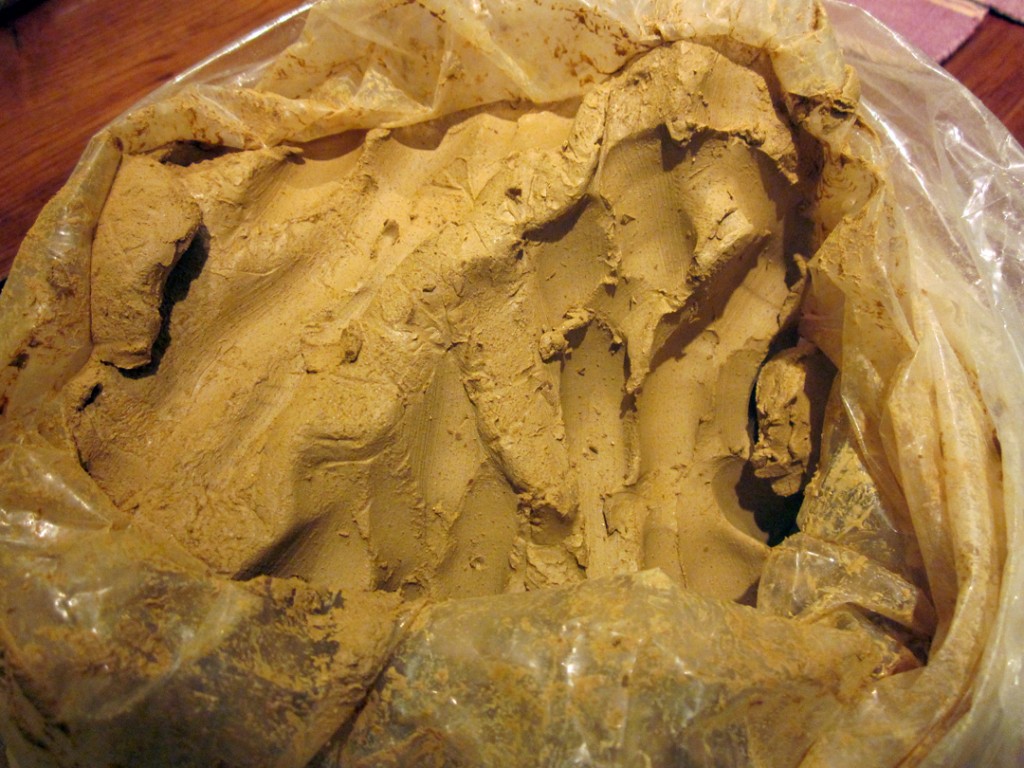
Oh boy! Wet clay, fresh out of the bag! The smell of it reminds me of vacations by Sierra lakes and rivers. Decomposed granite, water and rotting organics, mmmmmMMM!  This bag of lovely Sandstone Buff is from Quyle Kilns in the California Motherlode town of Murphys, so my nose is right on.

Fresh clay like this is sticky, mushy and makes great slime if you get it wetter. It takes any impression, any shape and, if it’s not piled too high or too thick – or if it’s supported – it holds as it dries. We’re not sure just how humans began to take advantage of the fact that clay changes in the fire,  but we know  that raw clay lined many Neolithic holes in the ground or baskets, the world over, and accidentally got baked hard. This particular feature of wet clay is a not-so-hidden agenda in the Beginning Ceramic Handbuilding class I’m currently teaching. First Project, after all the intros, handouts, clay studio tour and ground rules? The Press-Molded Wad Pot.

Forgive me a few more words and then onto the eye candy.

This way of using fresh clay is so obvious it’s almost NOT a clay handbuilding Official Method. At best it gets a sidebar or an “Also Try This” mention in the dozens of  books and websites I consulted for deeper understanding. Sometimes that mention is in the Coiling chapter, sometimes in the Slab working chapter. It doesn’t really get respect.

It deserves better and I’m giving it that because it’s a fabulous and supportive (pun intended) way to get comfortable with the forming properties of clay besides making lumpy mudpies. It  lets clay be clay and learners be learners. It directs attention to good clay skill-building: evenness, surfaces, top edges and drying, but keeps some training wheels on to help a thoughtful ceramic artist have the full experience AND a successful result. Here’s a pictorial walk through the only thing I’ve ever heard it called besides simple press molding: A Wad Pot.


Get yourself some wet clay, about 5 pounds, any kind. Find a container with an even top rim, without undercuts – so your pot or bowl will slide straight out of it and not get caught – like this “Popcorn Bucket” from the local dollar store. You can also use traditional plaster or wood slump molds. You’ll need  some thin plastic if your container isn’t made of something porous that will release the clay. Gather a few rounded sticks or spoons as smoothing devices besides your fingers. And start in.

Open that bag of clay and inhale deeply, just because. If you need to, line your mold with the thin plastic. Don’t worry about how wrinkled or folded it is, that’s part of the texture the finished pot will enjoy. (And a little secret: you can remove this wrinkling later by smoothing the outside if you’re called to it.)

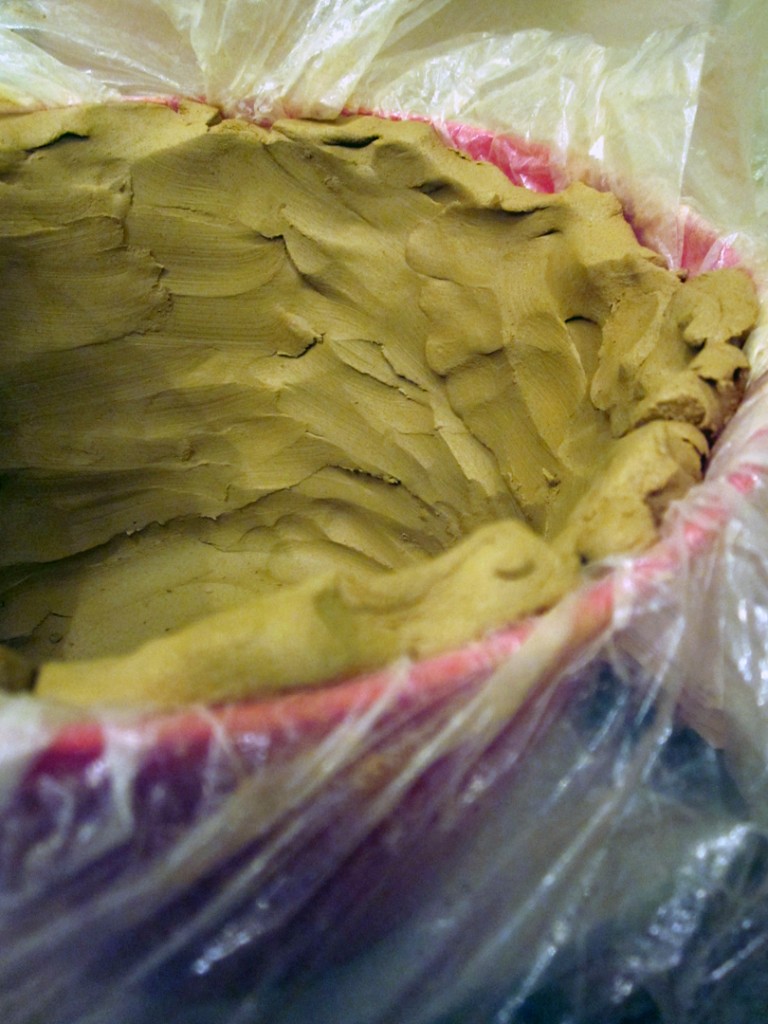
Grab a random-sized pinch of clay, maybe the size of a golf ball. Mush it around (aka: kneading). Pat it into a flattened shape,  1/2″ or  less thick and place it at the bottom of your mold. Do this over and over, lining the bottom and sides of your mold. Pressing the edges of each piece into the others, smoothing and linking the surface only as much as you want. Feel where the thick and thin places are and adjust accordingly. You will go back over it all when the mold is completely lined.

So, fast forward to a finished top rim edge, smoothed and strengthened, a bit of drying and an un-molding. Here’s what you’ve got:
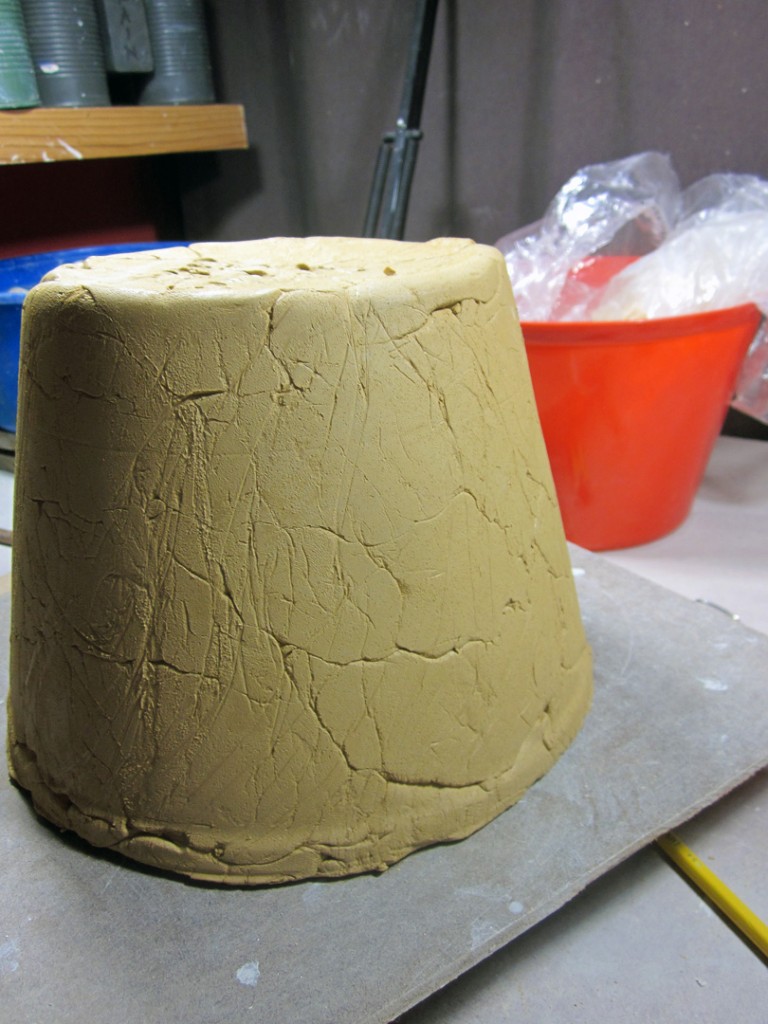
 

See all those great creases and wrinkles? Leave them alone for a great natural surface…or smooth them with a rib if you must. Press the bottom in a little so it will sit evenly and sign it.

I’m thinking you left the outside alone, so here’s the bisque fired version, wrinkles intact.
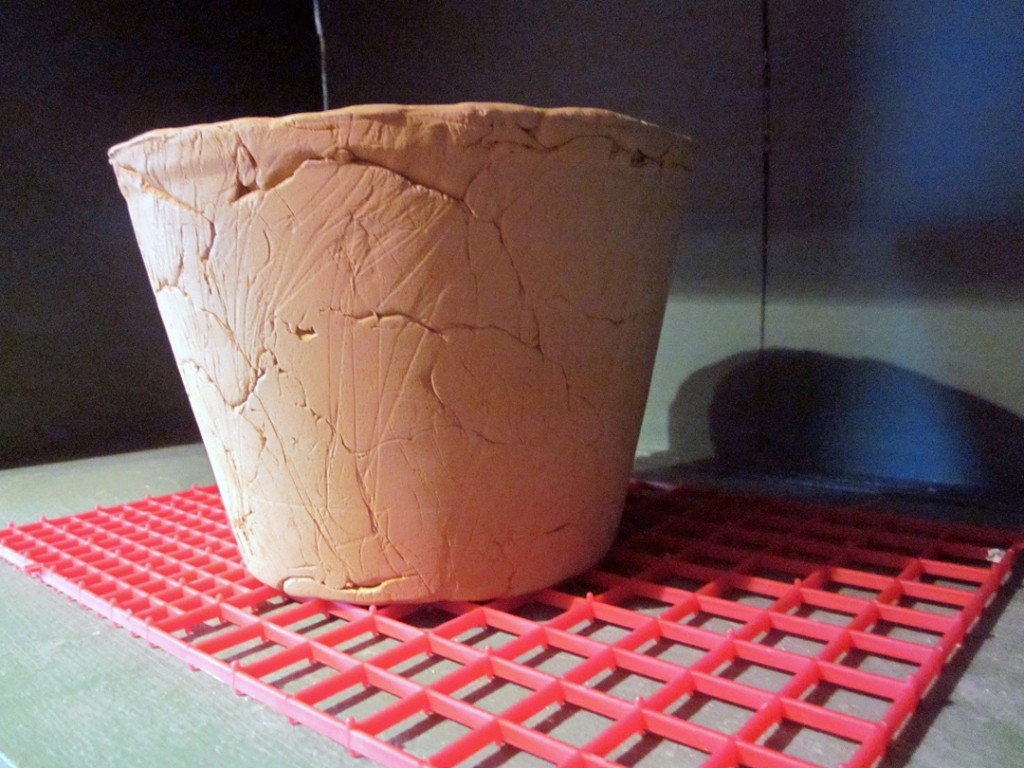


What serves to decorate this kind of pot and honor it’s hard-won (or is it hard-left-alone?) surface texture? How about a patina wash: thinned iron oxide wash brushed on and then lightly sponged off to leave it mostly in the cracks? It’s OK to glaze the smooth inside if you like. And that would look like this:
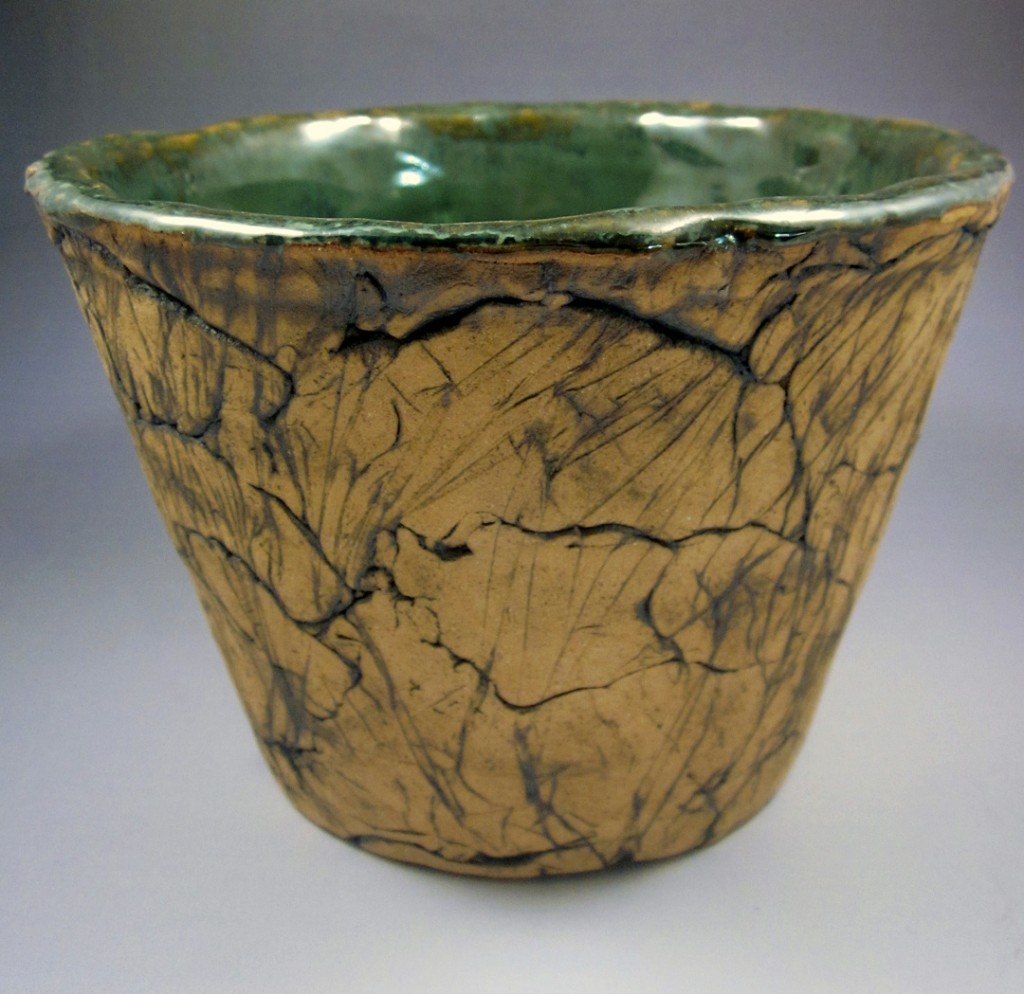
 

So, there you have it. An awesome and supportive first project for beginners….or anyone else needing a fairly assured way to make a pot. And quickly!

Variations are legion. Use different mold shapes. (Just make sure your clay will release easily.)  Use evenly rounded wads or coils or “floils” – flattened coils. Smooth the outside cracks. Add stuff to the top rim. Change the shape of the pot once it’s unmolded: square it up, push out from the inside, you know what to do. Don’t smooth the inside as much. Add handles or a top rim edging. The beat goes on.

As I finally get to posting this, my class is 2/3 over and going quite nicely. The second and third projects: Traditional Coiled Pueblo Pots and Pinched Japanese Style Teabowls have been introduced and students are working to finish and decorate to suit. More on the rest of the whole experience soon, of course.

Happy Clay Trails.
 

Share this:

You Cannot Fly Into Flying: Beginning Anything in Real Spacetime


You cannot tightrope walk by watching this YouTube clip. (But the person who created it is learning!)

You cannot watch and watch and watch,  read and read and read, talk and talk and talk, think and think and think about tightrope walking and say you are actually doing it.

The doing of the thing is the thing and that happens in Spacetime. And as that link you just read past will tell you, “Spacetimes are the arenas where all physical events take place.” Where you and your physical body are located right here, right now.  HERE = the 3 to 24 (it’s debatable) spatial dimensions.  NOW = the 1 temporal dimension (apparent agreement.)

OK, the watching, reading, talking and thinking will help line yourself up right for the doing, especially if you try to be fully present as you watch closely, read the right sources, talk to the right crowds, think about it in an associative and retentive  manner, and maybe – or even especially – run through the related physical motions. They will most certainly lead you to better observations, reading material,  conversations and cognitions galore.

Rehearsals, all!

And if they lead you to the doing part,  you might be so well-rehearsed in mind, body and spirit, you surprise yourself with how simple and honest it feels. Honey, that’s good rehearsing! As Olympic Gold Medal figure skater Scott Hamilton has reportedly said, it’s also “skating stupid.”  The doing falls out of you because you have successfully absorbed the Preparatory. The watching, reading, talking, thinking, even the pantomiming, have transitioned you to the Repertory.

Preparatory. That’s  still where I’m at with designing my Beginning Ceramic Handbuilding class.  The actions I’m involved with right now are definitely not the real teaching. All this gathering, editing, organizing and questioning are totally necessary to manage a good run when the time comes. If you want more of what’s going into that, my recent two posts here and here do some pretty elegant expository hand-wringing about “my process,” such as it is.

There is, however, a larger motivation for aligning myself with the vital differences between preparatory/repertory – or theory/practice – and that’s because the students who will come to study with me will experience their own version of it. How can I guide them as they transit the continuum from hearing, reading, watching, etc. to doing?

We both know that all the talking and reading and showing and sharing we do are but the foundational intro or interlude to touching the clay and moving it around with intention. Hell, we all can practice the valuable Coeleen Kiebert exercise of physically assuming the positions of our pots and sculptures, but it’s ONLY when we mold, pound, coil, pinch, carve, smooth, sponge, brush that we deeply know what this clay stuff is for ourselves.

Some of these beginners will undoubtedly run gladly off in many directions, full of joyful assumptions.  Wanting to do it all at once perfectly,  attempting to swallow the clay universe in one gulp.  Acting as if Spacetime didn’t include the sequential time part. That’s where I think the heart of my guide role is: pacing the doing. Intertwining the cognitive with the active in our tiny corner of the Wide World of Clay. Supplying a studied but ultimately idiosyncratic version of a sequential scaffold for them to climb around on, lift by lift.

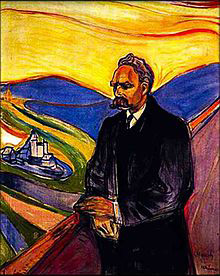
Friedrich Nietzsche (that’s him painted by Edvard Munch in 1906 in the top illustration) said it brilliantly, “He who would learn to fly one day must first learn to stand and walk and run and climb and dance; you cannot fly into flying.”

Clay work taught me patience and presence. Well, not so much taught as forced them upon me, as I was definitely of the Fly Into Flying bent as a newbie. My endless groundings and crashes lasted years more than perhaps needed. Could  I have spent more time on effective Preparation? Could I have had better scaffolding? Maybe. Then again, maybe not. Because of my experiences, I don’t expect to save any artist from their personal process. But I do believe the least I can do as their flight instructor is to shed a bright and true spotlight onto the highwire act and the ladder up to it in our spacetime arena and encourage them to give it a real try.

Class Nuts and Bolts: 6 Thursdays, 2-5pm, Session I: Feb 23 to March 29, Session II (with different techniques and projects): April 12 – May 17. Held at the Santa Cruz Mountains Art Center, 9341 Mill Street, Ben Lomond, CA,  831-3364ART.

If you’re so inclined, you can call or register online at www.MountainArtCenter.org. Class is $180 for Members/$200 Non-Members.

Next time: Those visual aids! (Yes, I know I promised them last post and the post before. Clay takes an uncertain amount of time and they’re just not done yet! Think I would know by now, do ya?)


Share this:

It’s Complicated: Distilling 30,000 Years of Ceramic Art into a Six-Week Beginning Handbuilding Workshop

OK yes, that title is a tad dramatic. But it’s not a needy and exaggerated untruth: I’m actively sorting and defining what I know and enjoy about the entirety of ceramic arts in order to hone in on the heart and soul of this Beginning Handbuilding class, taught by me,  starting at the end of this month.

And this week that honing process hit critical mass. It felt a little like peeking into a ramping raku kiln and watching for the powdery glaze on the pieces to liquify, come to a bubbling boil and then to smooth out again as both it and the ware it is coating becomes blastingly red-hot. And THEN comes the moment to shut off the gas and pull the pieces with tongs into their garbage can reduction chambers. Most of you ceramicists out there will understand this reference, but if you need a visual, here’s a good one.

All this week I gathered and listed and piled and flagged.  I re-piled and sorted and started a board of sticky notes detailing each project’s intended trajectory through the weeks. I assembled the needed demos, quotes, glossary, Important Things to Know and on and on. I culled (which was clearer and easier now) and kept the best.  A Beautiful Mind got nuthin’ on me!

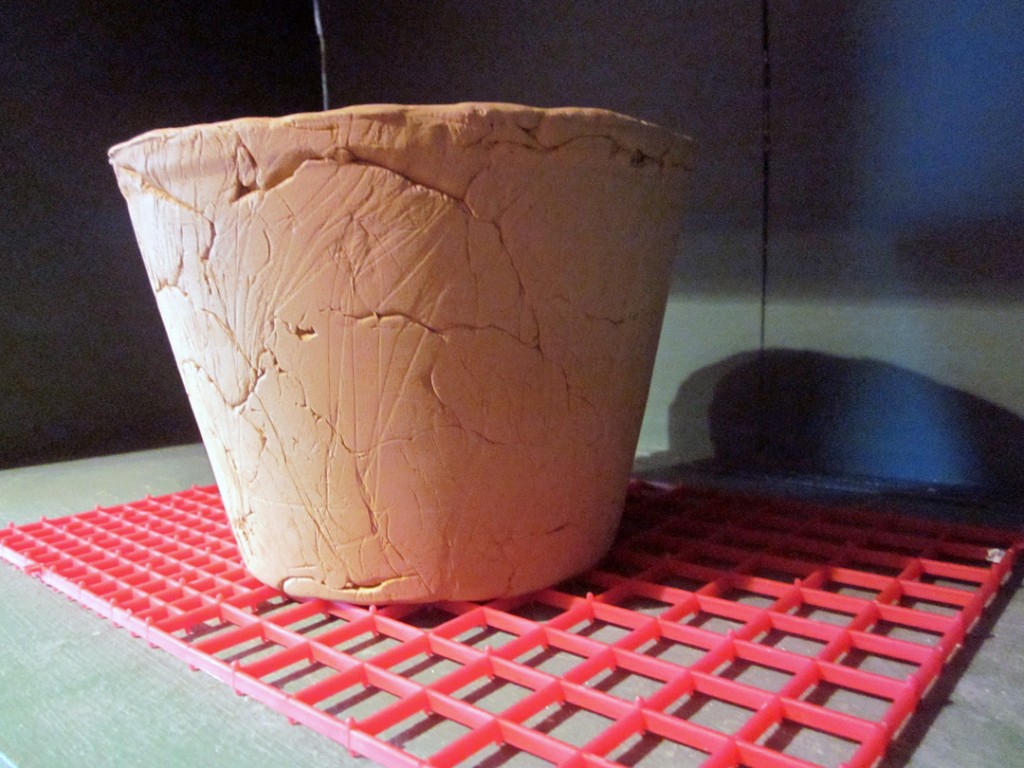
Last post I talked about how this class-formulating process amasses information. I think I mentioned something about comparing the ceramic teaching process  to cooking show demos, but I’m reporting in tonight that I’m not quite ready for that one. Maybe next week. I HAVE made one sample of a Press Mold Wad Pot, which you can see below,  but now I realize it’s the first of several needed to provide tangible illustrations of the important stages of just one of three comprehensive methods and techniques I will be teaching.

Press Molded Wad Pot at leatherhard

And that serves my personal understanding of Full-Service Ceramics. Sometimes students can connect the dots, but I find in ceramics it’s not all that easy. The whole process is un-obvious, far-ranging,  deceptively sidetracking and negotiable.

But that’s also the most important clue for me as as Interpreter and Guide: first and foremost, I need to have a profound and undistracted personal sense whereof I speak. If I gloss over, give the short shrift, make assumptions, it does not do the job in that satisfying way. I think I am connecting my own dots, retrospectively. As a matter of fact, I could re-title this post Things I Wish Someone Told Me Right Away.

And even then, the only way out is by doing it. So while I prepare and attempt to perfect my offerings for my new class and students, ceramics has also taught me to be more comfortable with imperfect and unexpected outcomes. With learners of all ages, that’s nearly a given. Years of helping clay handbuilding students has told me this amount of preparation is no less than the right amount, as cloggy and complicated as it can be. I’m glad it’s ONLY 30,000 years I need to review and condense and, like I said, I’m enriched and privileged to do it.

Class Nuts and Bolts: 6 Thursdays, 2-5pm, Session I: Feb 23 to March 29, Session II(with different techniques, projects and subject matter I still have to formulate): April 12 – May 17 held at the Santa Cruz Mountains Art Center, 9341 Mill Street, Ben Lomond, CA,  831-3364ART.

If you’re so inclined, you can call or register online at www.MountainArtCenter.org. Class is $180 for Members/$200 Non-Members.

Next time: Those visual aids!

Share this:

Crouching Teacher, Hidden Student: Crafting an Excellent Clay Handbuilding Class

Step right up and lookee here: I said YES when the enthusiastic folks at the Santa Cruz Mountains Art Center asked me if I would  be so kind –  and organized! –  as to offer a structured series of Beginning Handbuilding classes. That was a few months ago and now, here they come in just a few weeks. I better get this figured out.

I got thrown into the briarpatch at the outset, because in order to write not one course description but three of them  – Short, Long and For the Press – I needed to have my raw concepts of what these classes would be about aligned with my personal take on the ginormous field of ceramics. Nothing like starting right in.

Just what do Adult Beginners or Re-Newers want? Or need? What do I have to offer them? Could I parse this out and still keep it meaningful, soulful and artistic, for us both?

How much does my editing, formatting and delivery of this wide-ranging subject affect outcomes? I concluded it was puh-lenty and I would do well to start back at my own beginning, boil it down to the bare-boned basics and embellish prettily from there.

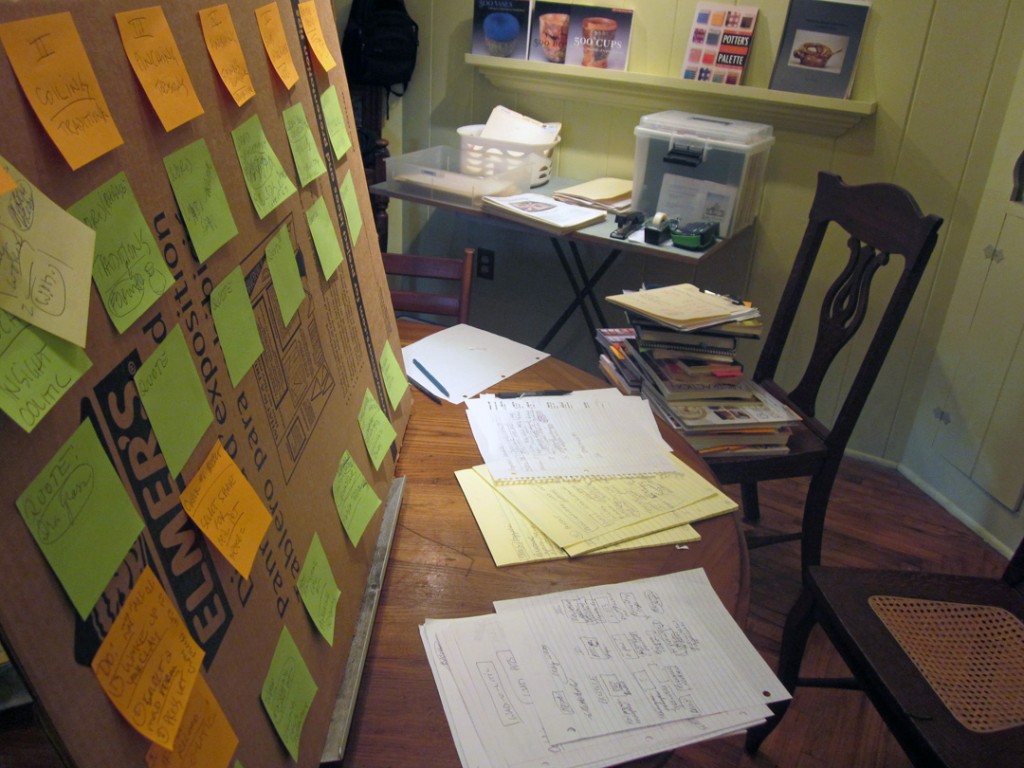
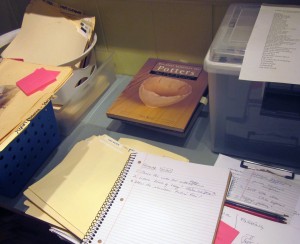
So what you see to the left is my long-time method of distilling knowledge: get a side table, dedicate it to the topic at hand, and proceed over the ensuing unfocused weeks to pile it high with everything which might be valuable to that cause. (It’s also how I wrote my college term papers, so I guess there’s a workable precedent in force.)
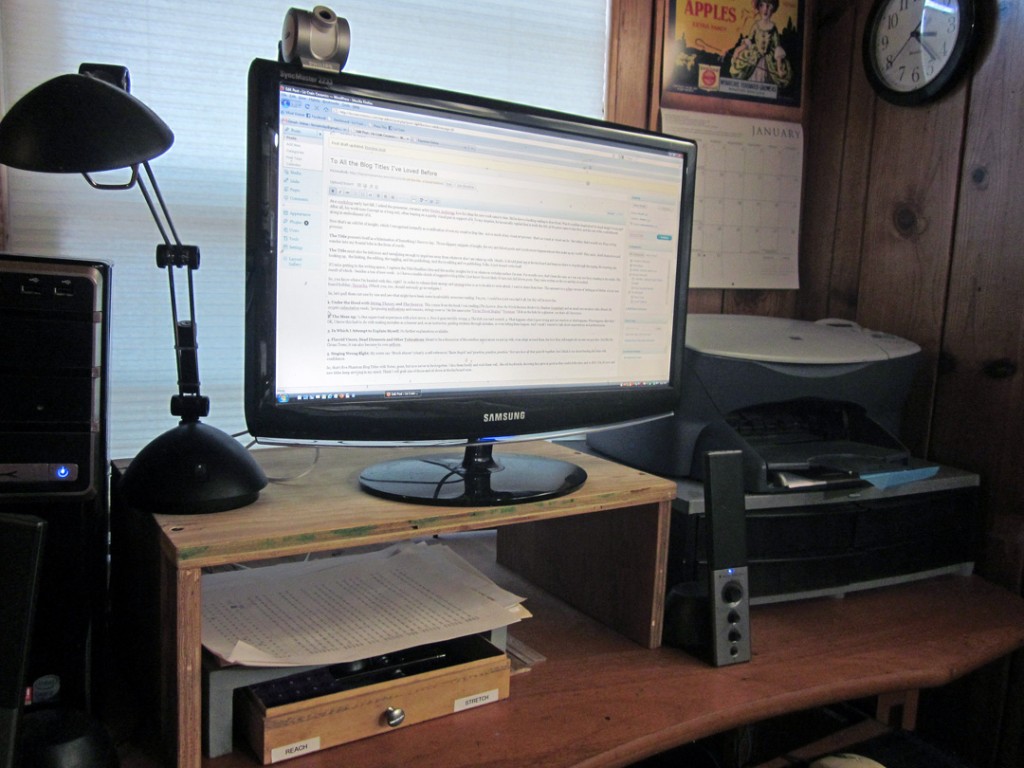
Supposedly Right-Brained Creatives respond better to horizontal, visual, tactile piled-up available information – as opposed to vertical files behind cabinet drawer-fronts –  and I agree: when I have a thought, a pertinent quote, a book, an article, a snippet of anything I suspect might be useful, I just throw it here, feeling rich and capable.

In good time, I will comb through the cornucopia and discover the inherent order there. Yes, I have a goal in mind, but the only way I realize it is to plow through and let it grab me. Inevitably the outcome is so much richer and denser than what I thought I was creating.

These stacks are certain to contain my decade-plus collection of notes and handouts from my stable of teachers too. Some of them have had genius ways of simplifying and Explaining It All….or genius techniques, genius timetables, and genius projects which I can freely channel, if not outright copy. I bow to those who gave this kind of effort before me, and I reap the harvest of their cultivation. Nobody comes out of nowhere.

And that’s really all there is to it. I’m no expert. I’m just someone who’s studied how to share and how to be a guide and to deliver substance. I’ve got some ideas on what sorts of things are good to know in the beginning and what sorts of things might logically follow.  I have theories on how to engage learners and how to aid them in discovering their own realizations and about how to foster the creative process as it relates to clay. Beyond that, what happens is what happens and I mean to stay awake to it. I’m a Hidden Student inside a Crouching Teacher.

Class Nuts and Bolts: It meets 6 Thursdays, 2-5pm, Session I: Feb 23 to March 29, Session II: April 12 – May 17 held at the Santa Cruz Mountains Art Center, 9341 Mill Street, Ben Lomond, CA,  831-3364ART.

If you’re so inclined, you can call or register online at www.MountainArtCenter.org. Class is $180 for Members/$200 Non-Members.

Next Time: A discussion of the super slo mo similarities between an illustrated ceramic process and cooking shows.

Share this:

To All the Blog Titles I’ve Loved Before

Is there a name for the Muse of Blogging?


At a workshop early last fall, I asked the presenter, ceramic artist Wesley Anderegg, how his ideas for new work came to him. Did he have a backlog waiting to draw from? Was it a sudden inspiration? A visual image? A concept? After all, his work uses Concept as a long suit, often leaning on a quirky visual pun in support of it. To my surprise, he laconically replied that in truth the title of the piece came to him first, and the rest of the work followed along in embodiment of it.

Now that’s an odd bit of insight, which I recognized instantly as a ratification of own my creative Step One,  not so much of my visual art process – that’s as visual as visual can be – but rather, that’s exactly my blog writing process.

The Title presents itself as a fulmination of Something I Have to Say.  Those slippery snippets of insight, the wry and dulcet posits and synchronous happenstances that make up my world?  They unite,  distill themselves and wander into my frontal lobe in the form of words.

The Title must also be delicious and tantalizing enough to impel me away from whatever else I am taken up with. Ideally, it should plant me at the keyboard and keep me there to slog through the typing, the inserting, the looking up,  the linking, the editing, the tagging, and the publishing. And the re-editing and re-publishing. Folks, it just doesn’t write itself.

If I miss getting to the writing apace, I capture the Title Headline Idea and the motley insights for it on whatever writable surface I’m near. For months now, that’s been the case, as I was way too busy cranking in the studio. The result of which – besides a ton of new work –  is I have a sizable clutch of suggestive blog titles I know I’m not likely to turn into full blown posts. They were written on the ice and the ice melted.

You know where I’m headed with this, right?  In order to release their energy and un-snag mine so as to be able to write afresh, I want to share them here.  This amounts to a cyber-version of  letting go of clutter, a la my new found holiday, Discardia. (Which you, too, should seriously go investigate and celebrate.)

So, let’s pull them out one by one and see what might have been some incalculably awesome reading. Yes, yes,  I could have just recycled it all, but this will be more fun.

1. Under the Hood with String Theory and The Swerve;  This comes from the book I was reading (The Swerve: How the World Became Modern by Stephen Greenblatt) and an email conversation with a friend. My cryptic subnotation reads, “proposing unifications and reasons, strings swerve.” On the same note: “Tuvan Throat Singing.” “Feynman.” Click on the links for a glimmer, cuz that’s all I have now.

2. The Mess-up; “1.One supervised experience with a hot stove. 2. How it goes terribly wrong. 3. The itch you can’t scratch. 4. What happens when it goes wrong and our reaction to what happens. What happens after that.” OK, I know this had to do with making mistakes as a learner and, as an instructor, guiding students through mistakes, or even letting them happen. And I recall I wanted to talk about expectations and perfectionism.

3. In Which I Attempt to Explain Myself; No further explanations available.

4. Flaccid Visors, Dead Elements and Other Tolerations; Meant to be a discussion of the needless annoyances we put up with, even adapt around, but how they still negatively invade our psyches. Yet, just like the Circus Trees, it can also become its own artform.

5. Singing Wrong Right; My notes say: “Brush abuser” (clearly a self-reference) “Skate Stupid” and “practice, practice, practice.” Not sure how all that quite fit together, but I think it was about bending the rules with confidence.

So, that’s five Phantom Blog Titles with Notes, gone, but now never to be forgotten. I kiss them fondly and wish them well,  like old boyfriends, knowing they gave as good as they could at the time, and so did I. Yet, it’s now Now and new titles keep arriving in my mind. Think I will grab one of those and sit down at the keyboard soon.

Share this: