My Art Buddy Karen: An Illustrated Panegyric

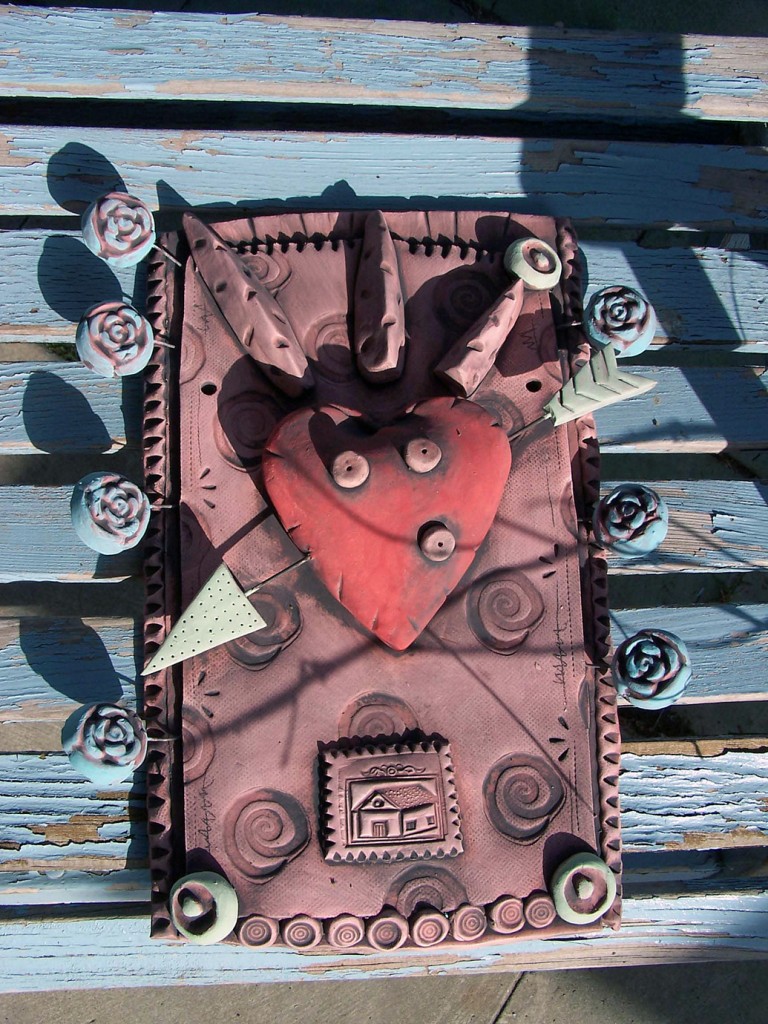
Love Karen Hansen's playful WallHeart

I could have said paean or laudation or even, dare I, encomium, but panegyric was the big ass word I needed for this public praise piece about my Art Buddy Karen Hansen.

So, without tons of backstory, and letting the photos describe her ceramic art, what’s good about Karen as an Art Buddy?
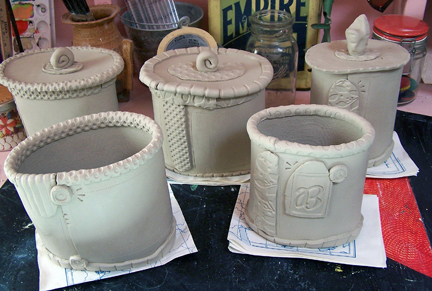
What's she DOING in there? (Karen Hansen, greenware)

She’s Magnetic. It’s got to be about Frequency (or is it pheromones? I forget.) No matter, when I’m in classes with her, I want to know what she’s doing, thinking, making. It matters to me a whole bunch. Even though our styles are divergent, they’re sourced from similar resonances and I simply need to be around that to channel the muse and protect me from the detrimental energies in the room.
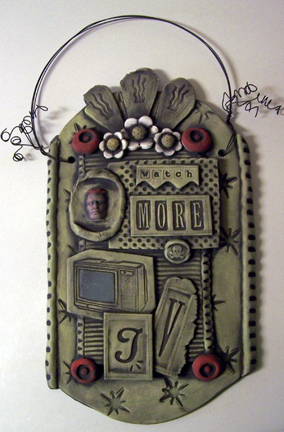
You know, deep down inside, TV is good for you! (TV Wall Plaque - Karen Hansen)

She’s Associative. That means that she collects her fascinations from nearly any quadrant and synthesizes them into enjoyable quirky meanings. A quick study of human foibles, she makes good fun of nearly every thing and every body. She’s facile with words and slippery thoughts. As a matter of fact, that might be her true medium. But it comes out in the clay too.
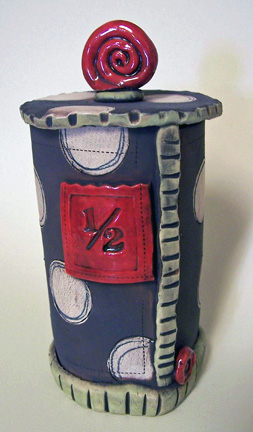
Half Empty? Half Full? Nope, just 1/2. Deal. (1/2 Lidded Jar - Karen Hansen)

She’s Versatile and Steady. Adaptive and Constant. Ever-changing and Predictable. Do I speak in parables and opposites? Yes. Because it’s true. I’ve probably quoted it before, but it was Steve Allen (or maybe Marshall McLuhan) who said, “The funny man (sic) is a man (sic) with a grievance.” If we go beyond the oppositions, we find the unifying core of humanity in both tragedy and comedy and I enjoy that skill in Karen.
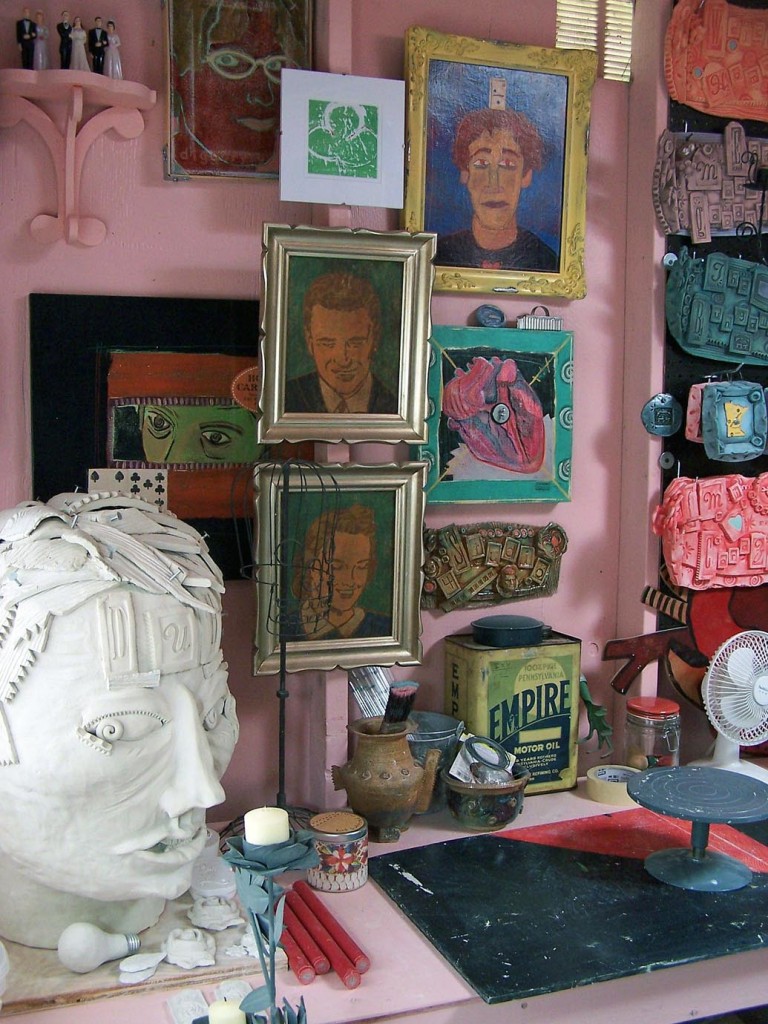
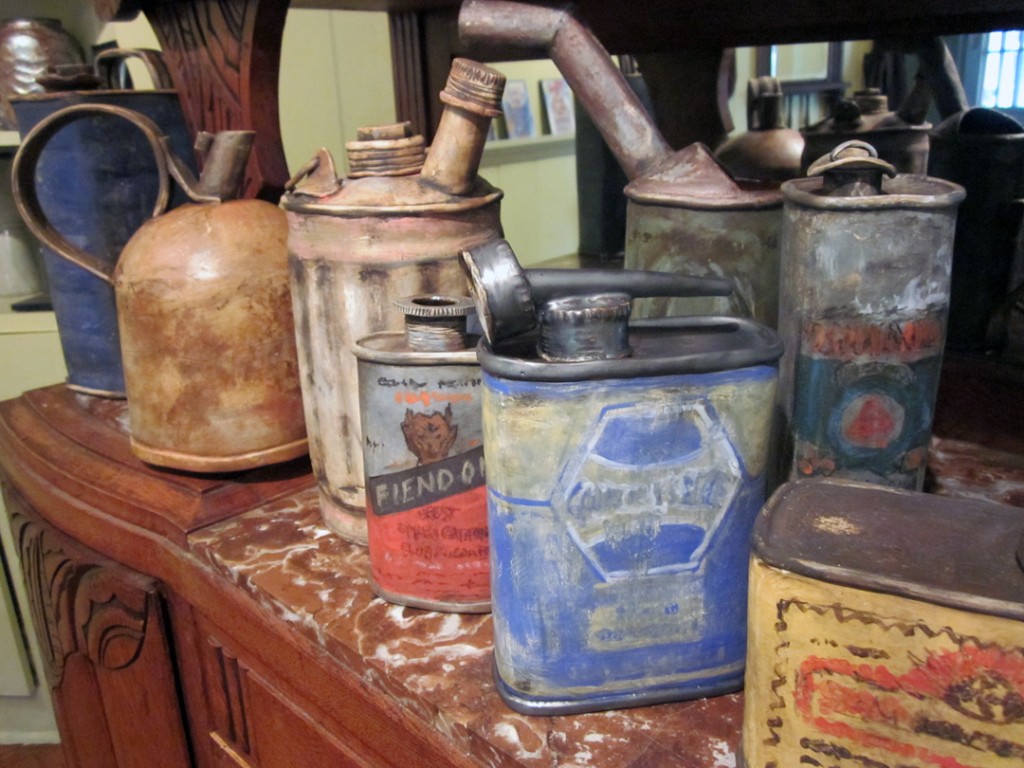
Karen's Playland (or one of them...) Hey, I see that oil can back there!

She Brings It Basically it’s a Full Catastrophe Package with Karen. Equally capable of shop talk, philosophy, baudiness, pop culture or fine art references, and animal humor, she most humbly reveals her passions. She can simultaneously complain and assess, with chuckles. She buys my art, too, astounding me.
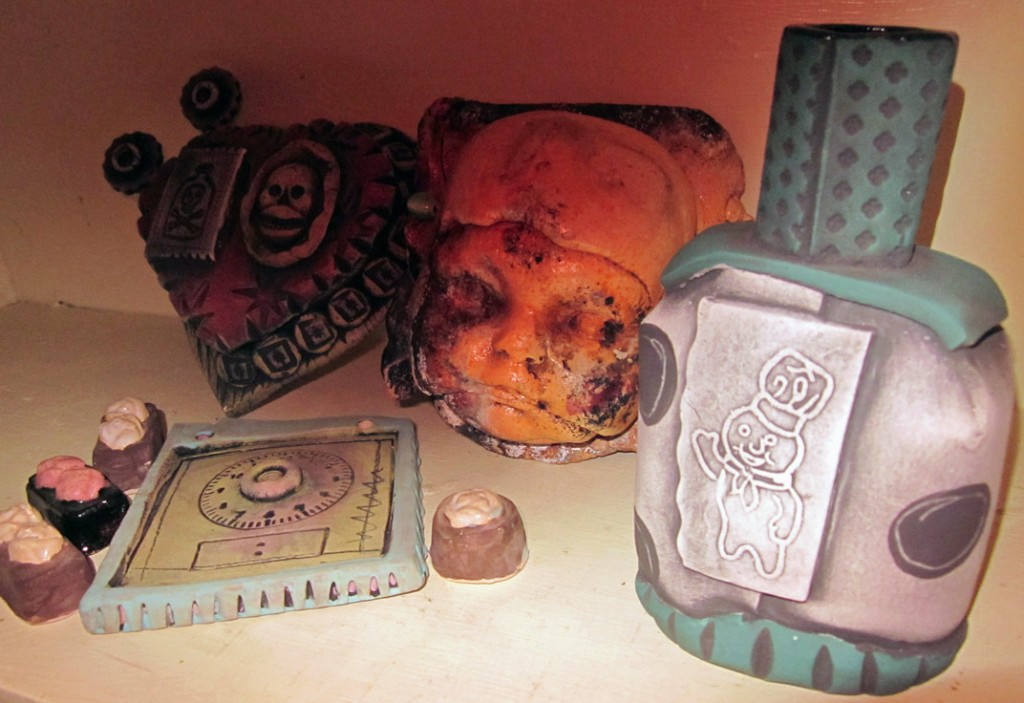
Skullheart, Pitfired babydoll head, Pillsbury Doughboy, Candies and dial tile...the beginning of my Karen Hansen art collection

Well, I mean to say I’m pretty fond of her. Art Buddies cannot be conjured. They ARE. I have a modest shelf of Karen’s treasures, pictured above. Some I traded with her, some I just purloined from her “extras.” Karen would modestly say these pieces reflect more about the eye of the beholder (me) than the maker (her), but I like them because they hold her special juju. Back to that vibe thing. And I want MORE stuff in this collection, especially of her newer work.
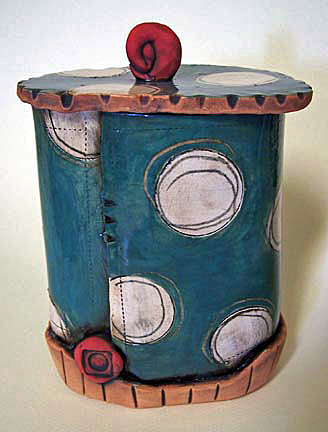
Polka Dots and Spirals for Everybody (Lidded Jar - Karen Hansen)

Fortunately for all of us, she recently entered the art market, a move I applaud. There’s her Etsy Shop, Polka Dot Clay Studio where you can see and buy lots more of her fun style for yourself. And there’s the Santa Cruz Open Studios Art Tour 2011, which we’re both still waiting to hear about our acceptance.
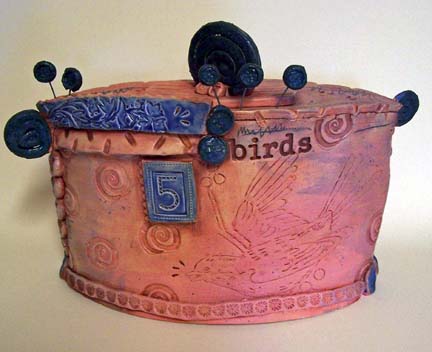
One Word: Birds (Lidded Jar - Karen Hansen)

Conspirators. Birds of a feather. Com-madres. That’s how I feel about knowing Karen and her art. Did I heap enough public praise? Did I use enough illustrations? I hope so.
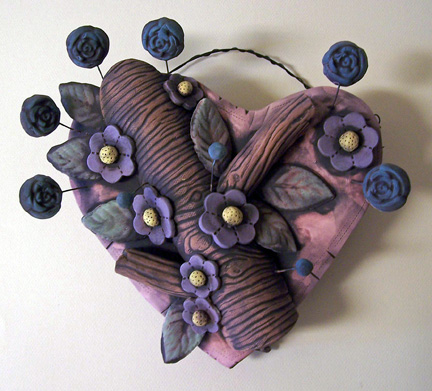
Corazon Espinado in the most exquisite way. (Wallheart - Karen Hansen)

Thanks, Karen!

Share this:

Takin’ It Outside and On the Road

In terms of ceramic art, mine and others, I did it up royally last weekend. That means I went for maximum effort and uber-luxe spectacle by attending and participating in both the California Conference for the Advancement of Ceramic Art AND the Santa Cruz Clay Show and Sale at Bargetto Winery.

Friday: To Davis, CA and back (2.5 hours each way) in 12 hours. The other 7 hours we were NOT in the car, we toured 45 exhibits and demos at the 22nd annual CCACA. What a whirlwind of wonderful work! I’m always dumbfounded by a few pieces and suitably inspired by a great many more. For the first time, I was kinda sad not to have the whole weekend there.

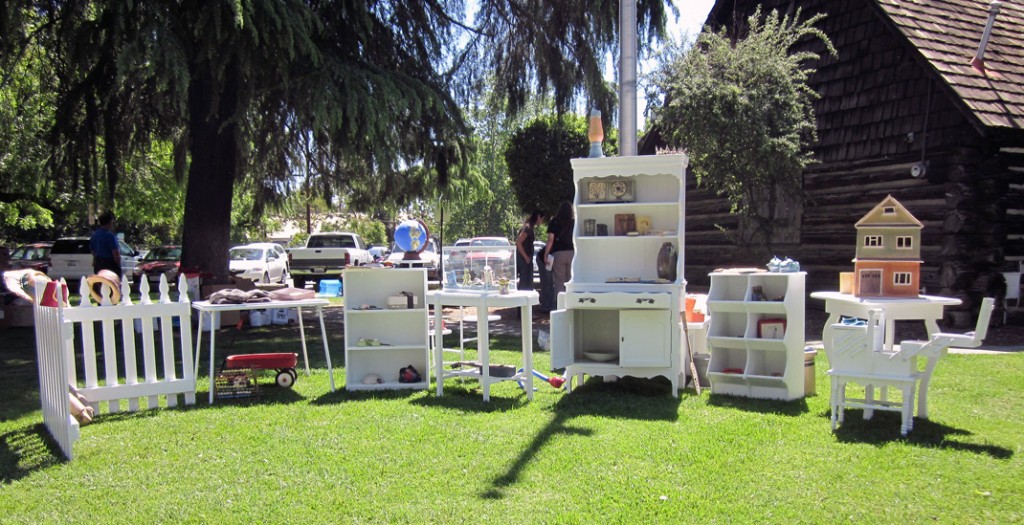
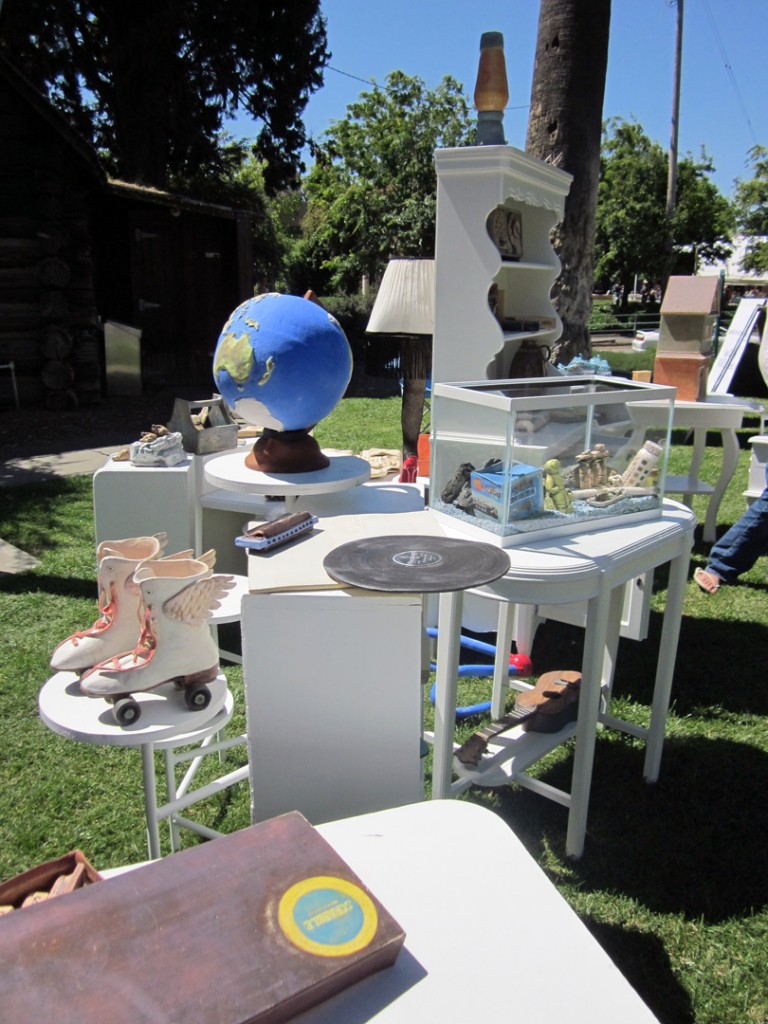
Biggest showstopper of course: Cabrillo College’s outdoor exhibit titled “Hard Times.” Described as “a social comment on the economic down-turn and a trompe l’oeil ceramic art installation.” My all-ceramic aquarium piece, which I have previously spoken of, was made for this. Here are a few shots, a street view and one from the uphill side of things.

It was almost TOO realistic!
Anything not white is ceramic!

All the “pedestals” are pieces of furniture. Everything else is a ceramic treasure. (Well, you already know the aquarium is glass…) It’s daring to take an outdoor space and fill it with such a large concept. And when the sprinklers went on Sunday morning, the aquarium even held some water.

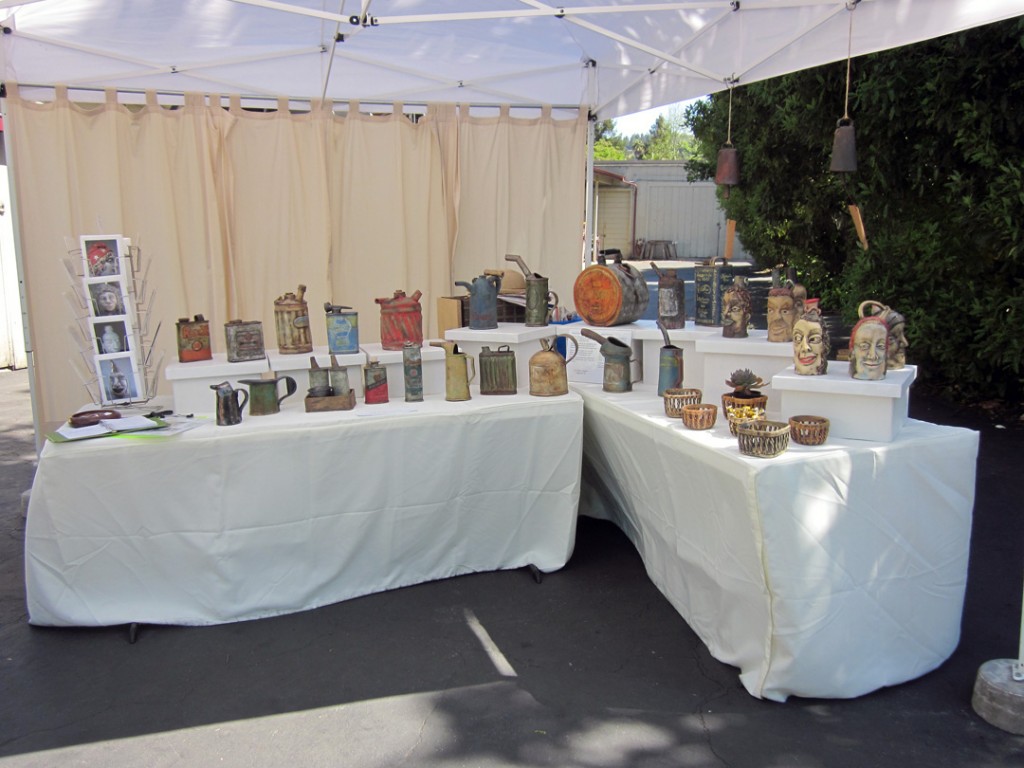
Saturday and Sunday: My first away from my studio outdoor ceramic booth set-up and sale. I called it a Pop-uP Pottery Village. It contained a population of around 25 local ceramic artists. We were all lined up in row and around a courtyard, representing an impressive range of pottery and sculpture, featuring artists old and new to both the craft and the sale. (Me? Definitely a Newbie on all counts, really.)

I found an authentically playful way to engage my visitors and my colleagues, felt surprisingly comfortable and pleased with how it turned out. At the end of Sunday, all my business cards were gone, I added a dozen new fans to my mailing list, made respectable sales, got a couple of leads to galleries (!) and found out I must have a bigger vehicle in order to safely hold the booth, furniture, display shelves and all the carefully packed boxes of breakable work.

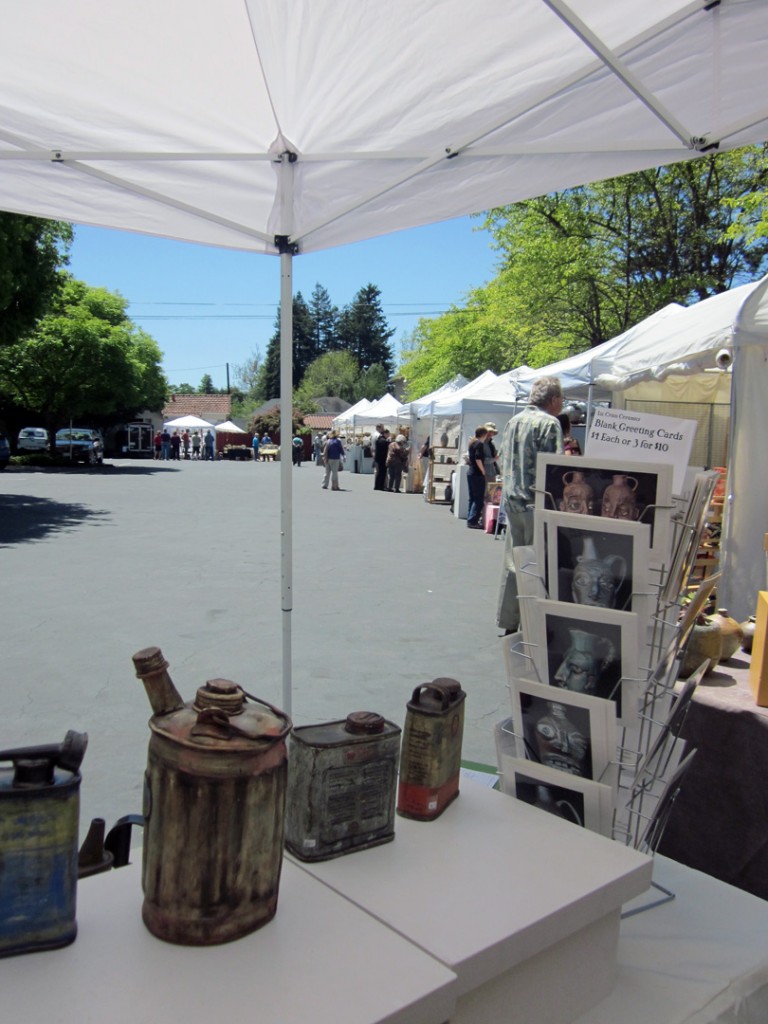
Here are two views of my booth set-up, front view and from behind the “counter.”

Yeah yeah, I really need some signs!
I asked my visitors if I was the appetizer or the dessert.

It was probably a good thing to be so incredibly busy because my game got really tight. Not only did I survive some completely new ventures, I was energized and encouraged by them. A few things still need to be put away, the studio needs a good clean-out, but I am happily aware of how getting out there completes the creative cycle for me. Each time round is less scary and confusing and I savor the recharged impetus to make more work. And, best of all, thankfully these two events will NOT be on the same weekend in 2012. Yes!

Share this:

“Apparently We’re Not Fish People” A Super Brief Photo Essay

This is the only kind of aquarium I really like ~Liz Crain

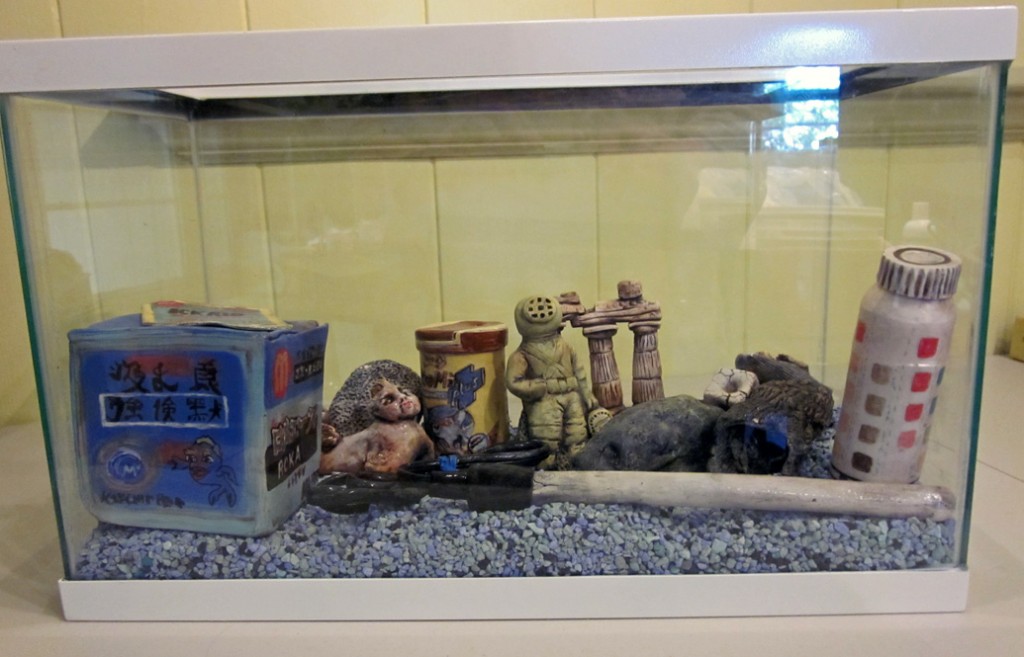
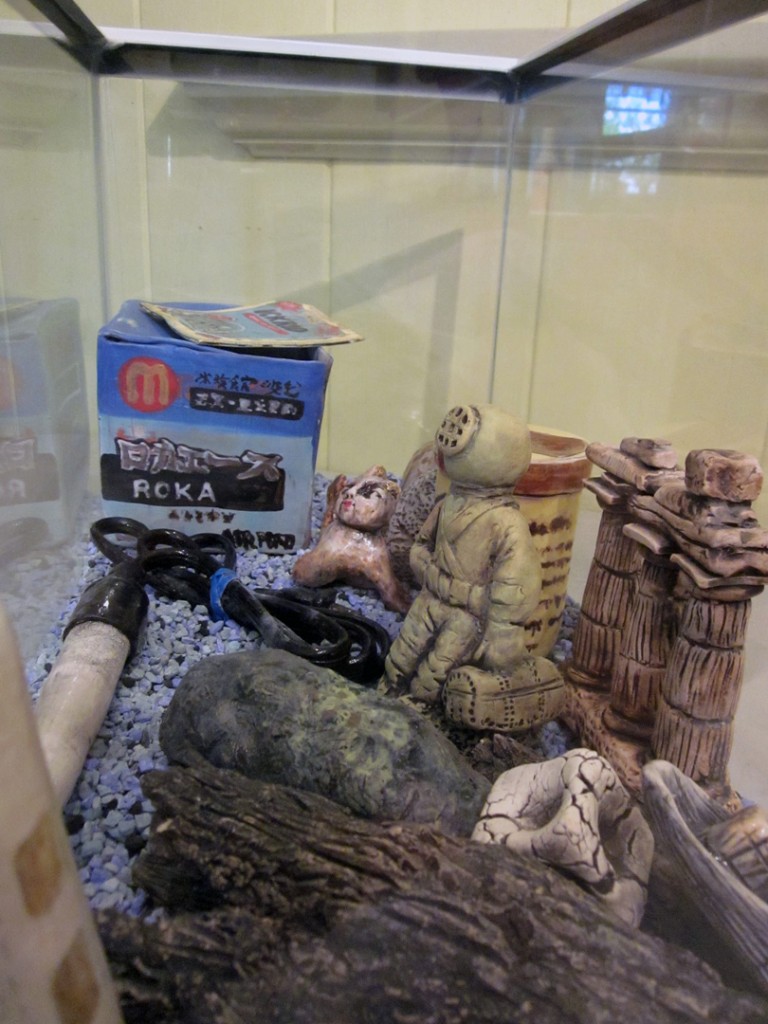
“Apparently We’re Not Fish People” is the title of my finished ceramic aquarium piece in the photo above. It’s all ceramic except the actual glass/plastic aquarium.

You may remember my earlier posts about making ceramic aquarium gravel. It was for this piece, and not a live aquarium!

Since those posts, I’ve made the super funky retro diver, the precious merbaby, and wrecked columns, the small Asian boat, rocks, shells and logs. Also the Japanese pump box, old school heater and cord, Tetra Min food cannister, Ph test strip bottle and Ick Rid sample envelope.

It’s all done in time to travel to the California Conference for the Advancement of Ceramic Art (CCACA, pronounced SEE-KA’-KA) in Davis, CA this weekend. It will be a small part of Cabrillo College’s outdoor installation entitled “Hard Times.” Photos of THAT coming soon.

I’m completely taken up with the rest of the preparations for not only the Davis conference, but for my first foray into selling my work at an outdoor ceramics show and sale with the Santa Cruz Clay folks at Bargetto Winery in Soquel. It’s packing and pre-packing all the time now…..Day trip to Davis Friday, then Saturday and Sunday in my booth in the Santa Cruz Spring sunshine.

So, off I scoot, leaving you with one more view of my latest narrative sculpture.

The title was taken from a Craigslist ad
Share this:

A Big Bowl of Overlapping Communities

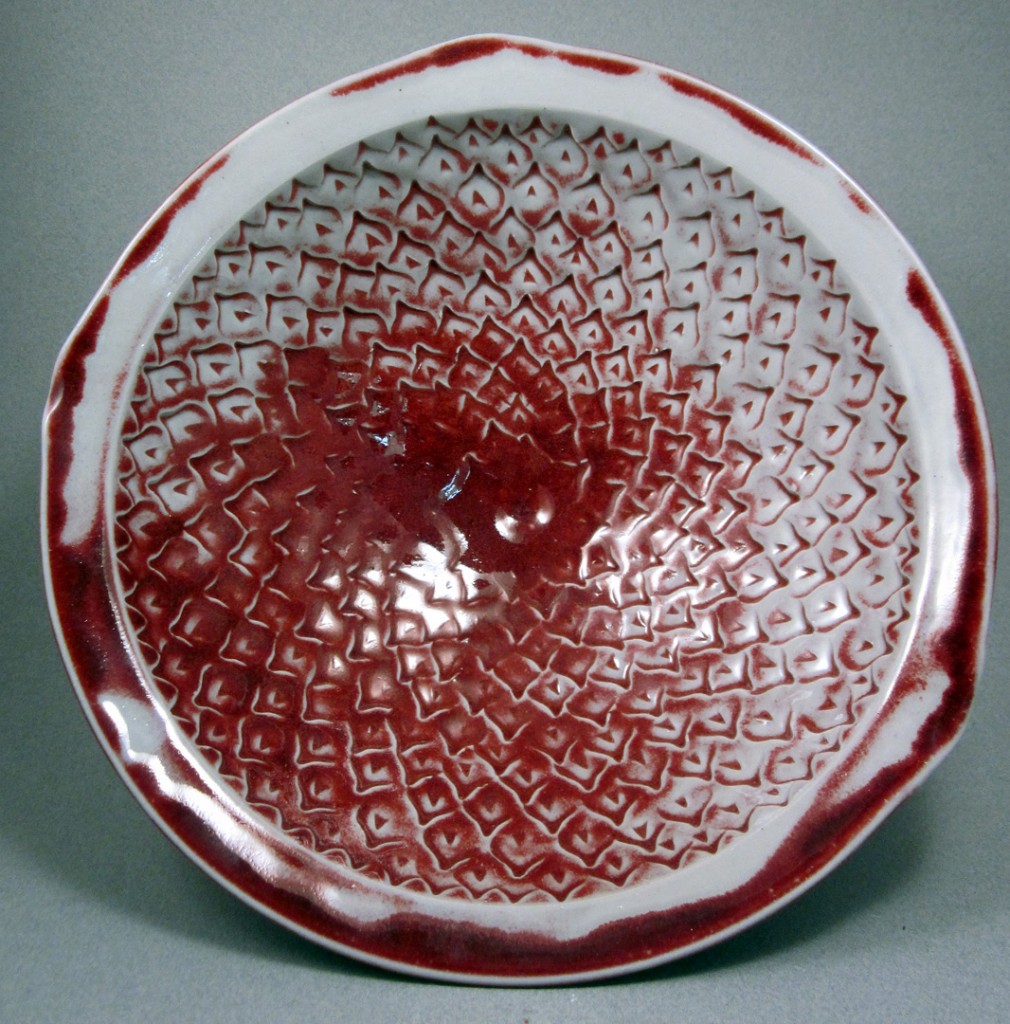
How much can one bowl contain? (Joseph McBride)

Last week I bought this sweet bowl directly out of the hands of my friend, mentor and colleague, Kathryn McBride. It’s not her creation, it’s her young adult son Joseph’s.

Joseph’s work is generally not offered for sale. He was donating it to a fundraiser and this was a scarce moment of opportunity. It’s a generous receptacle; a patiently hand-stamped, piebald copper red-glazed, evenly thrown bowl with a well-crafted foot and a subtle hand-pinched rim. I short-stopped it on its way to the fundraiser and sent my check to them instead.

When I placed it in the center of my round oak dining table, it began whispering, then humming, then ringing as clear as a temple bell, inviting me to not just notice the energies it has as a work of art, but to delight in the connections one bowl can forge in personal, local, and international ways.

Preponderance of the Personal

As a form in space, this bowl is a concave mandala, a vortex of radial symmetry. It dances with the Japanese notan of light/dark and positive/negative. It can hold anything and nothing equally gracefully.

The bowl also contains a few metaphoric miles of my journey with Kathryn, as we parented our similarly-aged sons and shared our personal and creative challenges. That Joseph — despite his many other interests and talents and being “raised in clay” — found his own way in ceramics is delightful and unexpected. I’m among a pantheon of proud Aunties.

Local Hands

Joseph told me he originally didn’t intend to even bisque fire this bowl — since it apparently didn’t meet his sliced-thin standards –but a fellow potter friend disagreed and sent it to the kiln unbeknownst to him. He eventually glazed it differently than his other bowls. It’s a bit of a renegade, this piece, off on another path entirely. A Wilbur the runt piglet saved by Fern. I was pleased that he was pleased I bought it.

An Ocean of Ripples

When the giant earthquake wracked Japan last March, it shook the brick climbing kilns of the ancient pottery town of Mashiko, crashing them to the ground. Like the tsunami waves that were generated throughout the Pacific Ocean, the circles of ceramic concern radiated out, touching the pottery community here in Santa Cruz. Many I know have pilgrimmaged to Mashiko. Those waves continued to England, too, because of the profound 20th century association of Bernard Leach and Shoji Hamada, which changed the ceramic cultures of East and West everlastingly.

Global Hands

Quickly, quickly, quickly a heartbroken but energetic group of Santa Cruz potters sent out the call: Please donate whatever ceramic work you can to a fundraiser, all proceeds going to help Mashiko recover its livelihood. Leach Pottery in England is doing similarly and I’m sure there are more.

Joseph was donating to this event and I bought his bowl. A lot of dedicated ceramic work came into being for what I hear was a supremely successful effort. Joseph’s rogue bowl of loveliness will help more bowls to be made in Mashiko.

All because I listened to it, the patterns and colors of one engaging big red bowl revealed spirographic loops of personal beauty, of friendships, of compassionate local artists and of a globally overlapping web of potting communities.

Share this:

What Do (Ceramic) Artists Want? A Blog Blast

Today's Kiln Yield (the good ones, anyway)

Before delving into the main question, here’s what I mean by a Blog Blast. For the past few years I’ve written longish posts. I compose and edit as I go (a not so good idea), making nifty essays which even I did not have time to read, even though they were worth it, IMHO. No more. Here’s to the short, pithy, candid and extemporaneous post. Longer than a Tweet or a Status Update, shorter than War and Peace, or even a term paper. Still worth it. Still friends.

All Bow!
I know what I want from my ceramic endeavors: the realization of what I had in my head to begin with, only better! I want the Kiln Gods to undo my ham-handedness, my fear and laziness, my lack of knowledge and brain farts. I want nothing less than Transformational Magic, that slice of perfection that no ceramic piece in the world has heretofore attained…until now. All bow.

I’m no different. And sometimes I do get that, briefly. As in performance arts, I feel I am only as good as my last kiln opening. So, when I don’t get the fairy dust, this is how I understand it.

Did I Take the Short Way Home?
Warps, cracks and breakage is the norm for mishandled clay. Glazing faults abound: wrong material/color choice, misapplied, too shiny, streaky, runny, bubbled. These are obvious flaws (except when they’re not because you wanted this exact messed-up result. After all, it’s contemporary art we’re talkin’ about!) Flaws are mostly not too fixable. Better to love and honor the quirky properties of clay and glazes on the front end. But when it does not go well in these departments, have your disappointment, even your everlasting shame and tantrum, then get out the hammer and start over. Oh, and learn to gently amend and refire a little too. Smash seven times, make anew eight. Get back on the cylinder that threw you. Learn to fly with your craft, bird by bird. No way out but the long way.

Got Appreciation for What Is?
What’s harder to understand is when a piece is gorgeous, but just not the specific gorgeous its creator intended. It happens to all of us: the heatwork of the kiln changes things and we hold treasure and call it trash only because it wasn’t what we ordered. The piece is too dark, off the expected color, bled or shrank weirdly. Whatever it is, it failed to meet our prior specs and we’re ready to smash once again. But wait! Tuck this one away somewhere, maybe for months, and then look at it without the pangs of former expectations. You might return to the “amend and refire” mode, you might decide it’s a true goner, or you might see it for what it is.

What to Want
And here’s the Tricky Bit: Don’t settle for “good enough.” Good: the enemy of Best, right? While it might sound like I suggest seeking only objective perfection, it’s really personal excellence which excites me. I may joke about wanting it all from the Kiln Gods, but I know what I alone put out there steeped in my heartfelt best comes back. Often better than I know to want, challenging me to keep stretching. I seek repeated opportunities to do exactly that.

That’s what (ceramic) artists really want.

Share this:

Unweaving a Rainbow: What Makes Something Beautiful?

Investigate Everything!

Some of you might not want to parse out what makes one thing more beautiful than another. I completely understand. Keats complained that Newton had “destroyed the poetry of the rainbow by reducing it to a prism.”

I’m here to meld that duality and I contend further that prism and poetry can co-exist fruitfully. In fact, in order to make my best art, I require that generation of The Third which emerges from Opposites.

I’ve tried the romance of just messing around with the crayons, the keyboard, and the clay, rather juvenilely hoping that the lightening bolt of genius will make a lucky strike. (Even sometimes thinking it actually did, for me.) Ultimately, though, it’s like playing Blackjack: while the odds are better than most games of chance, they still are in the House’s favor, not mine.

Goal-less and right-brained fooling around is creatively essential, but it is a warm-up: the beginning doodle, the free-write, the initial pinching, coiling and rolling. It so rarely makes it to that zen place of offhanded perfection, as much as we might be glancing over our shoulders to see if it did.

To take my craft into beauty and excellence –leaving the lightening bolts to shock themselves –I explored the nature of the creative process, studied Color Theories and The Principles and Elements of Art until I felt conversant and sometimes even fluent.

In other words, I got scientific and it helped. Now I could not only wonder at the rainbow’s glories, I could unweave it and put it back together in my own poetic way.

When I changed my art-making from 2D mixed media to 3D ceramics, a whole new set of loveliness standards came into play. What about Line and Form in Space? What about that Viewer in motion around the piece – or actually using it? What about Front, Side and Back? Top and Bottom?

So…. besides sticking to the work in my studio evolving my efforts, besides near constant conversations with mentors, colleagues, fellow enthusiasts and supporters, besides Art History courses and museum gallery visits, and besides deep thought on what motivates and thrills me, I read books.

And here are those that I deliciously don’t quite understand, but every time I delve through them, a little more is revealed:

The Nature and Art of Workmanship and The Nature and Aesthetics of Design, both by woodworker David Pye. If you click on the links, you will get descriptions and reviews. (Don’t miss the one for the Design book by wiredweird! I can’t describe the power of this book any better.)

Li: Dynamic Form in Nature by David Wade

And two exploring the realms of Sacred Geometry, whose philosophies lie at the heart of my seeking the Music of the Spheres in all I do.

Sacred Geometry by Miranda Lundy

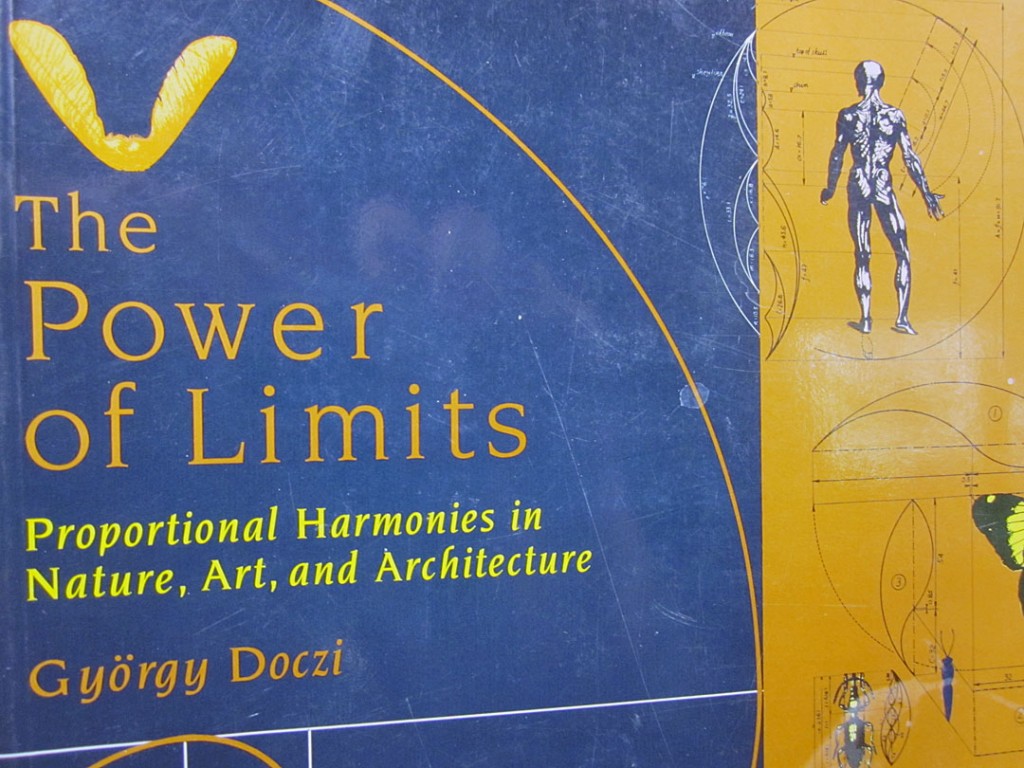
The Power of Limits: Proportional Harmonies in Nature, Art and Architecture by Gyorgy Doczi. The cover of my edition gives a hint of how the author connects the Golden Mean and the Fibonacci sequence to both the natural and visual world: with the language of mathematics.

Certain proportions occur over and over again joining unity and diversity

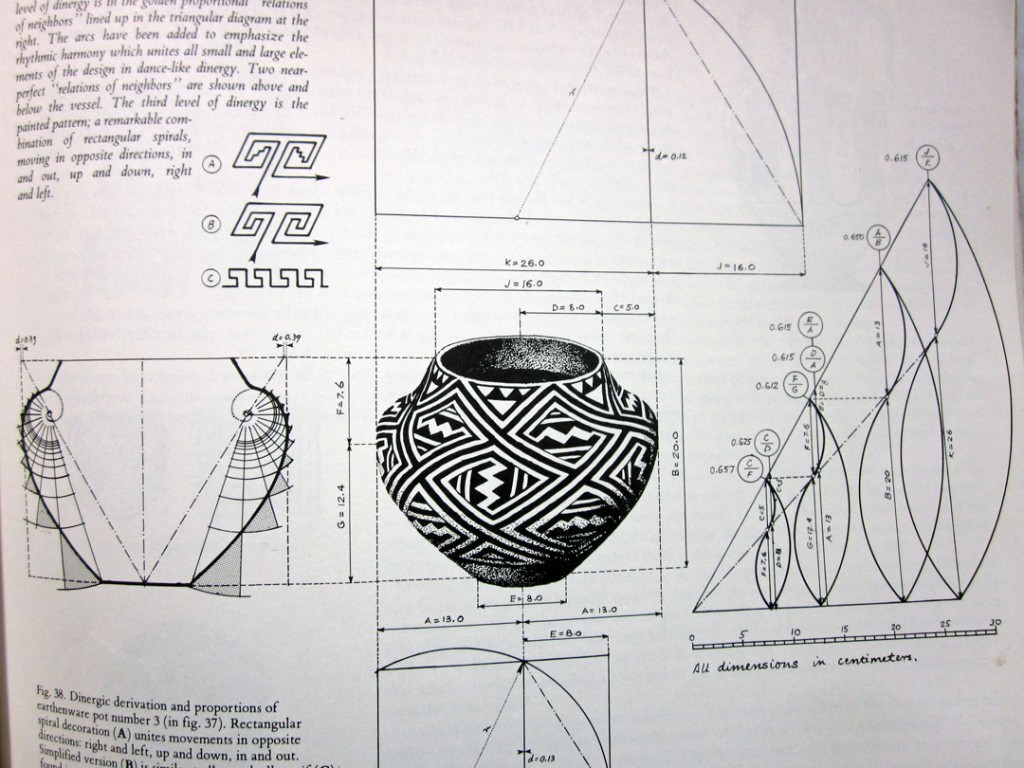
Herein lie richly illustrated pages with examples from plants, crafts, animals, Art: both ancient and modern, writing, the human body, music and more, all pointed toward a revelation of cosmic order so universal the author coined a new word for it Dinergy. “…Made up of two Greek words: dia — ‘across, through, opposite;’ and ‘energy.'”

A sample page.

So this is why Acoma Pottery is so pleasing! (Hint: maybe)

So what makes something beautiful? It’s surely not book learning and the methods of parsing, unweaving, reducing and dissecting! I don’t play around with numbers at all, I make art.

Rather, it’s about understanding that essential beauty’s out there, we’re all capable of perceiving it and here’s a Tiny Bit o’ Why. We may wildly disagree on specifics because there are many ways these patterns manifest.

Time, place, culture, narrative and materials don’t matter, yet there it is: A certainty of visual knowing instinctive and true.

I swear this knowing is how I sense when a work is done. There’s an out-breath, a hand relaxation, a satisfaction, all related to the cessation of seeking more for that piece. The rainbow is rewoven for now and I don’t need to measure it to make sure.

Share this:

5S Methodology, Mise en Place and My New Studio

Hot stuff wall paint is named Briquette

PART ONE: The Set-Up

Legions of artists fantasize about The Perfect Studio. Whatever the particular siting, configuration and appointments, it comes down to it being a vortex of personal creative energy where the conduits of genius become pure and we are blissful.

I’ve walked around a few incredible art-making habitats, many with zen views, which gave my artist’s soul the same frissons as Disneyland’s Peter Pan’s Flight did for me at age 6.

After the thrills, though, come the tidal waves of malicious envy followed by the dirty backwash of self-admonition: “A lot of artists don’t have any studio at all!” The Voice nags. So I go clean and rearrange one more time, dutifully attempting to bloom where I’m planted.

Sometime late last year I got a case of INeedABetterStudio-itis that was not induced by envy or guilt, but by a strong re-conceptualization of how I work best. I noticed things go better for me in my creative space when:

1. It has an open feeling with largish work tables and good task lighting.
2. It has dedicated places for tools, supplies, and other necessaries and they are clearly labeled.
3. I have separate areas for wet clay forming, bone dry and bisque work, and for decorating and photographing work.
4. Deep storage and side activity supplies are not visible.
5. It is inviting and pretty easy to keep clean.
6. There’s a private feeling, separate from my household.

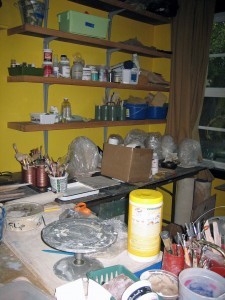
Those were the qualities that I kept seeking in the yellow space, a large back bedroom located off the laundry/pantry pictured below. But, I was asking too much of it. I wanted it to be an active studio as well as a major seasonal storage area, a photography studio, an Etsy Shop inventory and shipping area, a place to stage and prep my outside-the-studio teaching and volunteer projects, an art reference file cabinet and a mini meditation hall. No wonder I had no lasting success in wrassling it into a dream studio!

Free Swimming in the Creative Soup

It was clear, though, that I would not be moving off-site, out in the yard or be converting the living room. What, oh what to do besides more Sisyphean tidying? Eventually it occurred to me I could switch out two rooms by moving the active studio around the corner and down the hall to the off-the-beaten-path red room, taking only the necessaries with me and leaving the other functions behind to be joined by the exercise equipment.

And that is what I did. See the just-moving-in shot at the top of the post.

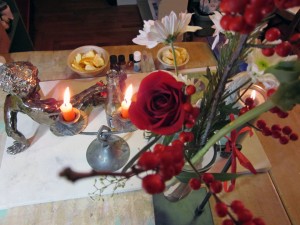
A few weeks later, I performed a dedication ceremony thanking “the divine cockeyed Genius assigned to my case“, by clearing and blessing the newly-born space.

Flowers, Candles, Oranges, Incense, Salt and Rattles

PART TWO: The Never-ending Conclusion

As I continue to pay attention to what I need in my studio (to make it vortex of personal creative energy by opening the purest conduits to genius and thereby fostering my ultimate bliss,) I make adjustments.

I stand when I work, so I propped the tables up on bedrisers and topped them with HardieBacker board, a smooth and durable work surface. As a bonus, the higher tables make the storage beneath them accessible without groveling.

I can reach everything on all the shelves, no footstool required, and I am able to keep stuff nearest to its likely use.

I swung the decorating table 90 degrees to create more elbow room, found sturdy, stackable clementine boxes to hold everything on the shelves and labeled them, got rid of the odd-shaped wareboards, threw out the broken and moldy and gave away anything not often used.

Albert Einstein, an earthly genius, said, “Things should be made as simple as possible, but not any simpler.” In the spirit of simplistic balance, I am scrutinizing my remaining tool collection and questioning why I have 8 cut-off wires, 16 needle tools, 23 ribs, dozens of similar wooden modeling tools, a deep drawer full of sponges and a whopping 212 brushes – I just counted them!

I think the bulk of these need to go. They are going.

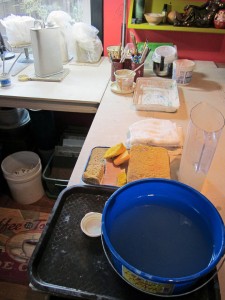
In practice, I only use about 20 favorites from all categories, which I keep handy on my right side along with my water tub, spray bottle, sponges, hand towel, brushes, slip container, and a cache of beloved sticks, straightedges and dowels. It’s an artist’s version of a mise en place, which works really well and I have begun to hone.

I now drive a custom cockpit of ceramic creation. Here’s a non-action shot (because an action shot would be less clear.)

A way of working that works

My entire studio is becoming a pretty decent personal version of Japanese workplace organization called 5S Methodology

1. Sorting (Seiri)
2. Setting in order (Seiton)
3. Shining (cleaning) (Seiso)
4. Standardizing (Seiketsu)
5. Sustaining the discipline (Shitsuke)

There are three other Ss that accompany this methodology: Safety, Security, Satisfaction. While they mean something different for factories and schools, I see them more as positive emotive qualities, emanating from the newly organized and clean space, helping me feel professional by fostering my sense of privacy, comfortable confidence and pleasure in my craft.

It’s a practice, this studio functionality perfection biz, but, I swear, now that I don’t need to kick a fire lane in to the work area every time I enter, only to stand there both fog-brained and hyper-distracted – essentially pre-defeated by the disarray – I’m making better art and having a way better time at it too.

Share this: